

Christine Whelan, April 16, 2026, Volume 7, Issue 16
It’s Spring Migration Time!
“This is the best time of year to see birds in Fort Erie”, says Marcie Jacklin, Fort Erie resident and avid birder of over 35 years. “Until the first week in June, we will see so many birds that winter down south, coming from even as far as South America.” Some will stay and some are just passing through.
“They will fly mostly at night. This helps them avoid predation.”
Birds in flight can be detected on radar. “They can be seen doing what looks like hops. They’ll do a big flight one day when the weather conditions are good, rest and feed up for a day or two, then keep going, all the way up here, and past, some to the Arctic.
Marcie belongs to all three Niagara nature clubs and the Buffalo Ornithological Society. Currently, she is on the Board of the Ontario Field Ornithologists and the Niagara Regional Coordinator for the Third Ontario Breeding Bird Atlas (2021-2025). She received the 2021 Canadian Wildlife Federation’s (CWF) Stan Hodgkiss Outdoorsperson of the Year Award.
“A lot of my favourite birds are called warblers. There are about 40 species. Starting now, but more in particular in May, is usually the only time we get to see them in Fort Erie because they’re passing through, going further north.”
Robins are no longer as much a symbol for spring as before, as we now see them throughout the winter months. “Some years ago, the horned lark was the symbol, but they seem to be wintering here now, too.”
The northern robins, the ones we see in the winter, who are fatter and darker, with more feathers, will be the ones that will now go further north. The ones who have gone south will now come here. “So, they’ll all shift,” Jacklin explained. “They all have these very interesting strategies for overwintering.”
The ‘symbol of spring’ title goes to the red-winged blackbird. “The males will come up first. They all come at once; you’ll suddenly see and especially hear them everywhere. The females fly up later.”
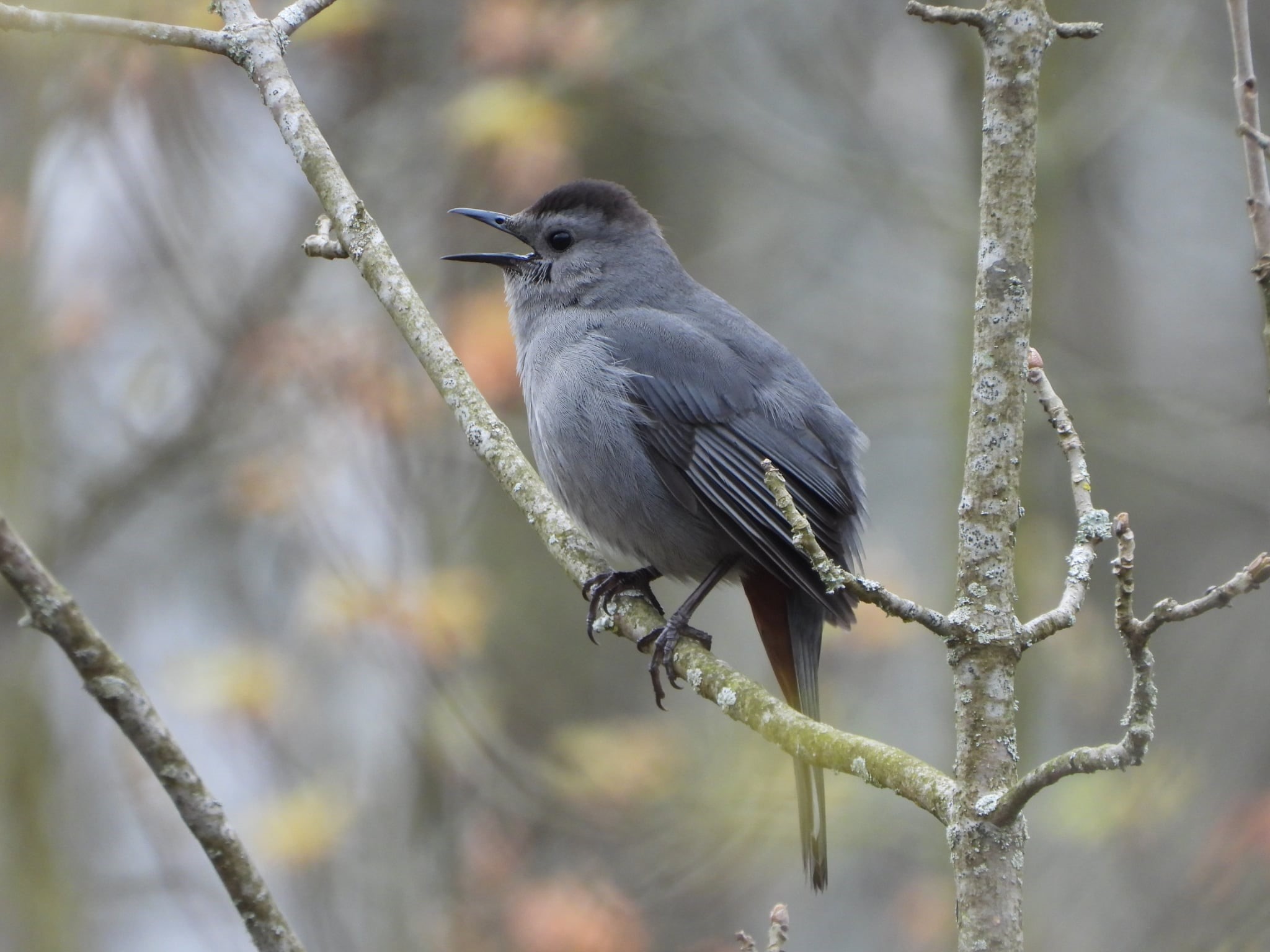
Watch for the Gray Catbird and Baltimore Orioles. “The Orioles love oranges. Put out a piece, and they’ll come right up to you.”
The hummingbirds arrive at the end of April. “Get those feeders ready!” The website to track the hummingbird heading our way is: hummingbirdscanada.ca/migrationmap
“There are a lot of species, especially in Fort Erie, that are called range extensions. That means they are Carolinian Canada species. They are more typically found in locations like Florida.
“A surprising example is the cardinals, which in the 40s and 50s were not here. They’ve just kind of slowly edged their way north as the temperatures got warmer.” Laughing, she added, “It’s a funny thing to say after this winter, but they are actually getting warmer, so the cardinal is able to survive.”
Although they can stand the Canadian winters, the cardinal tends to chirp through the colder months, only to break out in song as the temperature begins to rise. “And they have two larynxes so they can actually sing with themselves. They have two calls.”
Another bird that our area sees more of during the winter these days is the dark-eyed junco. During the summer, they live further north, so we are actually their winter resort. “They’ll breed in Algonquin. I don’t think we have any breeding records for juncos in Niagara.”
Marcie encourages all bird enthusiasts to find a cheap pair of binoculars, if you haven’t, get a pair, and get out there! If you want to use a birding app, she recommends Merlin.
“This is the fun time of year,” adding, “Especially if it rains early in the morning. Remember, the birds are up in the sky overnight, and if it rains, it might rain birds.” The rain would push them down to land on the ground.
Shelter and Food
For the birds that are here for the colder months, the recent, difficult winters have been challenging. “When it’s been very cold for extended periods of time, with lots of snow, their ground food is covered up; it’s very tough on them. The more trees that are cut down, the less shelter there is for them.
“When we have those very windy, very snowy, very cold storms, a lot of birds struggle because there’s no place for them to go. I know this is a major cause for the massive decline; their habitat is lost.” Adding, “Just in the last fifty years, we’ve lost about three billion birds,” quoting a study done by Cornell Laboratory of Ornithology and Bird Studies Canada.
“I think people are starting to see it at their feeders,” Marcie says. She’s lost some regulars at her own.
How Can We Help?
By setting up our backyards for challenging times, planting the right bushes and trees, we can provide shelter and food. Jacklin explained it’s important to plant native bushes and trees. “The ornamental ones that most nurseries sell are very beautiful, but they have no nutrition for the birds and insects.”
Our native insects will go towards the native trees and bushes because they recognize them and find the right nutrition there. The birds will then find the insects in these native trees. Certain bushes also have berries that the birds can eat while sheltering.
Marcie says our feathered friends prefer it wild. “There are studies that say, if there is wild food available to the birds, they won’t come to our feeders as frequently.”
She assures it’s important to do the research. “For example, you might find a maple tree at a nursery, but it might be a hybrid, which may not be as nutritious for the native insects.” Watch for labels that say “Native”.
Wetlands in Fort Erie
Wetlands are vital ecosystems where land is covered or saturated with water, either permanently or seasonally, acting as a transition zone between water bodies and dry land.
“This is particularly important for Fort Erie,” Jacklin stated. “Fort Erie really was, historically, if you look at the really old maps, a swamp. We’re building on a swamp. The problem is, local knowledge is not being listened to. There were opportunities for development on those sites, but built smartly so that the wetland could be protected.
She explained that when many trees are taken down, the surrounding areas will become flooded when it rains because the trees absorb so much water. “This is going to keep happening as more development in wetlands occurs.
“That water’s got to go somewhere. And when there is development on wetlands, we pay for it. We pay for having everything unplugged or ditch digging,” she commented.
“It’s time for Fort Erie to have the kinds of places that look after wildlife and are corridors so wildlife can move from one habitat to another, also so that the community can have some contact with nature,” noting that there are other places in Niagara that have wildlife corridors — Grimsby has Forty Mile Creek, St. Catharines has Cherie Road Park.
Meeting Marcie
Jacklin says she’s trying to get out in public as much as she can to help educate people about birds. She spoke on April 11 at the 11th annual Niagara College Bioblitz and will be speaking at the Fort Erie Library on July 18 about owls.
“I lead hikes for the Little Red Coffee Shop every once in a while.” Adding, “And they are for complete novices.” Watch for announcements on the shop’s Facebook page.
To keep in the loop with any nature hikes in the area, follow the Bert Miller Nature Club Facebook page. Want to get even more involved? Join the club!

